
Overall methodology
REFFRACTEUR aims to transform Europe’s high‑temperature industries by developing the next generation of sustainable, circular, and digitally enabled refractory materials. The project addresses the urgent challenges of decarbonisation, circularity and digital transformation in EU’s high‑temperature industries and brings together the entire value chain (from raw materials to end‑of‑life recycling) to deliver solutions that reduce environmental impact, strengthen industrial resilience, and enhance European technological sovereignty.
Through the training of 15 doctoral candidates, REFFRACTEUR also builds a new generation of experts capable of designing advanced materials, deploying digital tools, and driving innovation across steel, cement, glass, and other energy‑intensive sectors.
🔧 Methodology
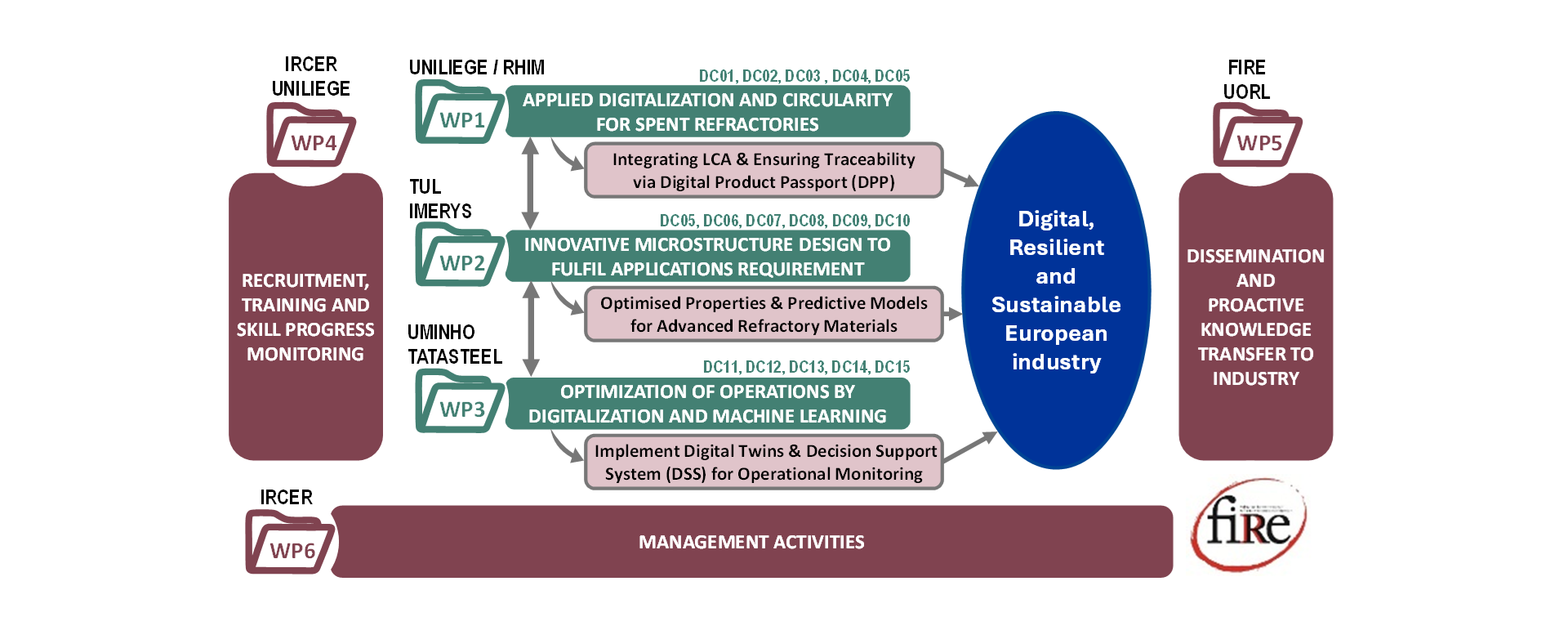
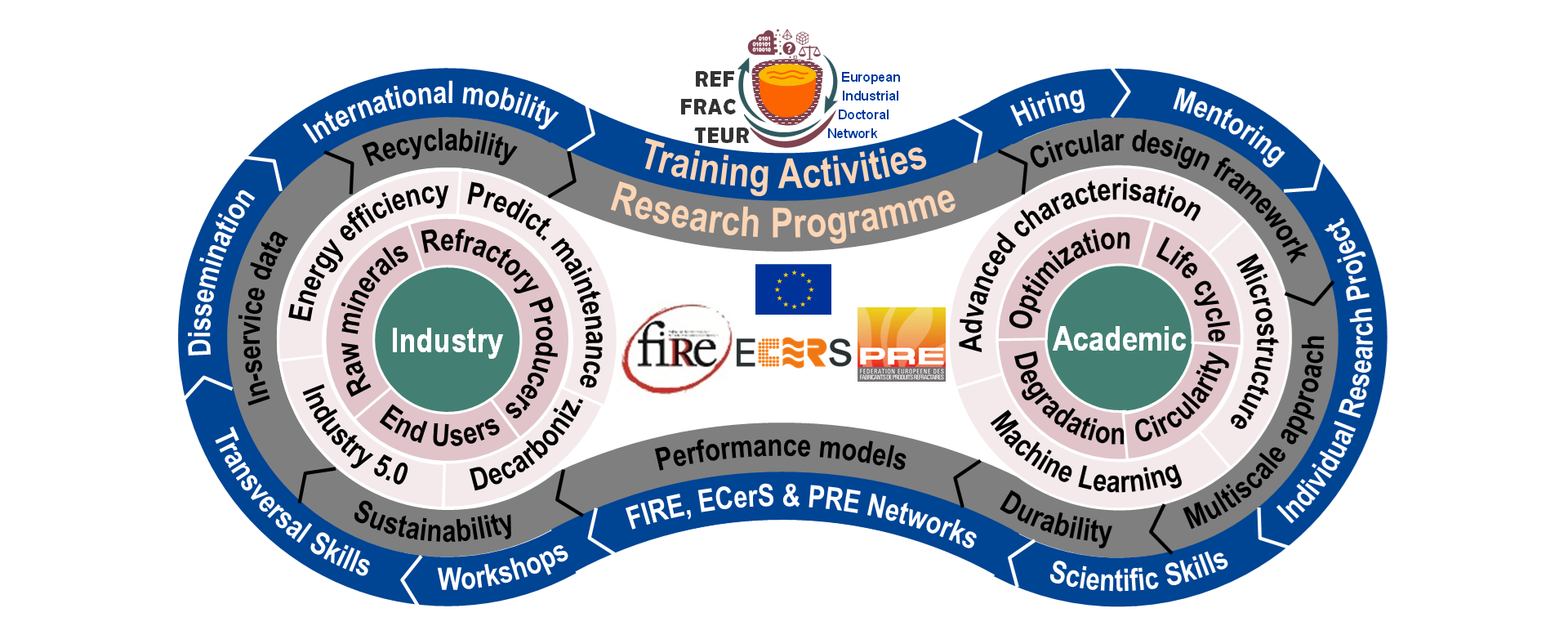
REFFRACTEUR follows an integrated, multidisciplinary methodology that links materials design, digitalisation, and operational optimisation into a single innovation loop. The project is structured around three scientific pillars:
- Digitalisation & Circularity (WP1): Development of Digital Product Passports, life‑cycle assessment methods, and AI‑driven quality control to enable traceability, recycling, and sustainable raw‑material use.
- Innovative Microstructure Design (WP2): Creation of low‑carbon formulations, cement‑free binders, and recyclate‑rich castables, supported by advanced characterisation and multiscale modelling (FEM/DEM).
- Operational Optimisation (WP3): Deployment of physics‑informed digital twins and decision‑support systems to improve refractory performance in service, reduce energy losses, and optimise maintenance and scheduling.
Together, these work packages create a continuous feedback loop: data from industrial operation informs material design; new materials are validated in real environments; and digital tools integrate performance, sustainability, and operational insights to guide future improvements.
WP 1 - Applied digitalization and circularity for spent refractories
WP1 focuses on building the digital and circular backbone that will enable Europe’s refractory industry to transition toward low‑carbon, resource‑efficient and fully traceable value chains. WP1 will develop and implement digital solutions to enhance the recycling, traceability and resource efficiency of refractory materials and create the first sector‑specific Digital Product Passport (DPP) for refractories.
The work combines life‑cycle assessment, automated quality control, and interoperable data platforms to unlock high‑value reuse of spent refractories. This includes designing a DPP that captures composition, processing history, performance and provenance, developing LCA methods tailored to refractory recycling and deploying AI‑based sorting and classification for fine fractions that are currently under‑utilised. A cloud‑based data architecture will connect DPP, LCA, sensor data and digital twins, enabling secure data exchange and decision‑ready dashboards for industry.
Together, these innovations create the foundation for a circular raw‑material ecosystem, reduce landfill and support compliance with upcoming EU Digital Product Passport regulations.
PhD positions focusing on this work package: PhD 01, PhD 02, PhD 03 and PhD 04.
WP 2 - Innovative microstructure design to fulfil applications requirements
WP2 focuses on creating the next generation of refractory materials that are cleaner, more durable, and more circular than today’s solutions. The work centres on understanding and engineering microstructures so that refractories can withstand extreme thermal, chemical, and mechanical conditions while dramatically reducing their environmental footprint.
This work package explores new formulations that incorporate secondary raw materials, low‑carbon binders and optimised grain structures. Advanced characterisation tools and multiscale modelling help reveal how microstructural features influence cracking, corrosion, thermal shock resistance, and long‑term degradation. By linking these insights with real industrial requirements, WP2 develops materials that perform reliably in hydrogen‑rich atmospheres, fluctuating thermal cycles, and other emerging low‑carbon process environments.
Ultimately, WP2 delivers high‑performance, recyclable, and climate‑fit refractory solutions, forming the material foundation for Europe’s green and digital industrial transition.
PhD positions focusing on this work package: PhD 04, PhD 05, PhD 06, PhD 07, PhD 08, PhD 09, PhD 10, PhD 11 and PhD 12.
WP 3 - Optimization of operations by digitalization and machine learning
WP3 brings the digital transformation of refractories directly into industrial operation. Its goal is to understand how refractory linings behave in real furnaces, kilns, and reactors, and to use that knowledge to optimise performance, reduce energy losses and extend service life.
At the heart of WP3 is the development of hybrid digital twins (models that combine physics‑based simulation with data‑driven machine learning). These twins integrate sensor data, thermal and mechanical modelling, and operational parameters to predict wear, detect anomalies and support maintenance decisions. By linking material behaviour with process conditions, WP3 enables operators to anticipate failures, schedule interventions more efficiently, and reduce CO₂‑intensive downtime.
The work also supports broader decarbonisation goals: better‑performing linings reduce heat losses, improve furnace efficiency, and help industries transition to hydrogen‑rich or electrified processes. WP3 ultimately delivers a suite of digital tools that make high‑temperature operations smarter, safer and more sustainable.
PhD positions focusing on this work package: PhD 11, PhD 12, PhD 13, PhD 14 and PhD 15.
WP 4 - Recruitment, Training and skill progress monitoring
WP4 is dedicated to shaping a new generation of experts capable of driving the green and digital transformation of Europe’s high‑temperature industries. It brings together academic excellence and industrial know‑how to create a comprehensive, intersectoral training ecosystem that equips young researchers with the scientific, digital, and entrepreneurial skills needed for future leadership roles.
This work package designs and delivers a structured programme that blends advanced scientific modules with hands‑on industrial experience, covering topics such as multiscale characterisation, AI‑assisted modelling, circularity strategies, and sustainability assessment. Alongside technical training, WP4 strengthens transversal competencies — communication, project management, innovation, and responsible research practices — ensuring that researchers can operate confidently in complex industrial environments.
A key feature of WP4 is its emphasis on mobility and collaboration. Participants engage in international exchanges, joint workshops, industrial site visits, and cross‑sectoral events that foster a strong community and accelerate knowledge transfer across the entire refractory value chain. By integrating scientific depth with real‑world exposure, WP4 builds a durable training framework that will continue to benefit European industry long after the project ends.
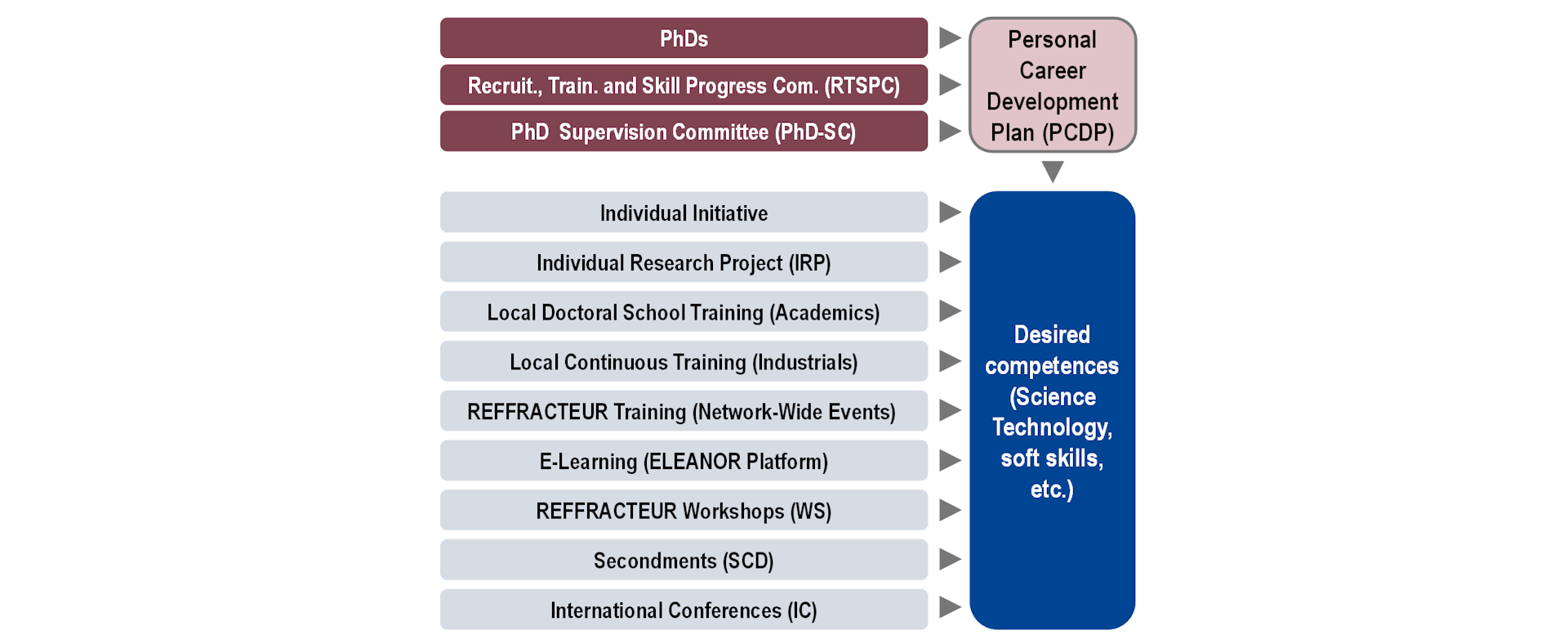
Schematic diagram of the training types covered within REFFRACTEUR:
WP 5 - Dissemination and Proactive knowledge transfer to industry
WP5 ensures that the knowledge, tools, and innovations developed within REFFRACTEUR reach far beyond the project itself. Its mission is to maximise scientific, industrial and societal impact by making results accessible, actionable and visible across Europe’s refractory, materials and high‑temperature process communities.
This work package coordinates a comprehensive dissemination strategy that includes scientific publications, conference participation, technical workshops and collaboration with major European networks. It also supports exploitation planning, digital tools and sustainable practices that can be adopted across the value chain.
A strong emphasis is placed on outreach and public engagement. WP5 develops communication materials, interactive demonstrations, and educational content to raise awareness of the role of refractories in the green and digital transitions. By connecting industry, academia, policymakers and the wider public, WP5 strengthens Europe’s capacity to innovate and ensures that REFFRACTEUR’s achievements continue to generate value long after the project concludes.
WP 6 - REFFRACTEUR management activities
WP6 ensures that the entire REFFRACTEUR initiative runs smoothly, efficiently, and with maximum scientific and societal impact. It provides the organisational backbone of the project, coordinating activities across all partners, monitoring progress and ensuring that research, training and innovation goals are delivered to the highest standard.
This work package oversees strategic planning, financial and administrative management, risk monitoring, and quality assurance. It also ensures that collaboration between academic and industrial partners remains strong and productive, enabling seamless knowledge exchange across the full value chain.
A key component of WP5 is its focus on impact and visibility. It supports communication, dissemination and exploitation activities, ensuring that project results reach industry, policymakers, and the wider scientific community. By aligning technical achievements with European sustainability and digitalisation priorities, WP6 helps position REFFRACTEUR as a reference initiative for the future of refractory technologies.
Overall, WP6 provides the governance, coordination, and outreach framework that keeps the project coherent, ambitious and aligned with its long‑term mission.