
Apply now for 15 PhD positions! DEADLINE EXTENDED to Wednesday 24th June 2026!
REFFRACTEUR (Digital REFractory FRAmework for a Carbon-neutral and Resilient indusTry in EURope) addresses these challenges by gathering a unique consortium spanning the entire refractory value chain, from raw materials to end-users, across academia and industry. The project will train 15 Doctoral Candidates through an innovative programme combining advanced research in materials science, process engineering, digital tools (AI, digital twins, and sustainability (life cycle assessment). Each researcher will benefit from dual academic/industrial supervision and spend at least 50% of their time in industry, ensuring strong intersectoral skills and real-world impact.
REFFRACTEUR will deliver: (1) new sustainable refractory materials with improved durability and recyclability; (2) the first unified circularity framework for refractories, integrating digital product passports and life cycle assessment; (3) validated digital twins and AI-based decision-support systems for predictive maintenance and energy optimisation; and (4) an open, standardised data backbone to accelerate innovation and knowledge transfer.
By embedding training, research, and innovation in a single European network, REFFRACTEUR will strengthen Europe’s industrial sovereignty, reduce dependency on critical raw materials, and position the EU as a global leader in sustainable, digitalised refractory technologies. The project’s outcomes will directly support the EU’s climate, circular economy, and skills agendas, creating lasting impact for industry, society, and future generations of researchers.
Refractory development is now a climate‑policy and strategic‑autonomy issue. EU objectives (–55% GHG by 2030, climate neutrality by 2050) and the Clean Industrial Deal intensify pressure on energy‑intensive sectors, alongside circular‑economy and critical‑raw‑materials ambitions. Carbon pricing (EU ETS) and CBAM increase the cost of CO₂, so lower‑carbon refractories and longer‑lasting linings become a direct lever to curb carbon expenditure and keep plants competitive under tightening regulation.
At the same time, low‑carbon process routes (H‑DRI, electric arc furnaces, low‑carbon clinkers, carbon capture) introduce new service environments: H₂/O₂‑rich atmospheres, stronger thermal cycling and corrosion from alternative fuels. Global competition in clean‑tech manufacturing is accelerating. Accordingly, priorities have shifted from durability and cost alone to environmental performance, combining microstructural engineering with life‑cycle thinking (purer chemistries, recyclable binders, lower‑carbon raw materials). Circularity is pivotal: ~28 Mt of spent refractories are generated annually, yet recycling remains limited and several inputs are import‑dependent, calling for better sorting, characterisation and processing to close loops and recover value.
Life‑cycle assessment and product carbon‑footprint frameworks increasingly quantify and steer improvements. In parallel, the sector is digitalising rapidly. The Ecodesign for Sustainable Products Regulation will require Digital Product Passports, enabling traceability of composition, use‑phase and end‑of‑life data; for refractories, DPPs can track identity, performance and recyclability from production to dismantling. Operators are deploying sensors, IoT and digital twins for real‑time lining monitoring, predictive maintenance and energy optimisation, while AI supports in‑line quality control and wear/failure prediction.
Delivering these shifts at scale requires skills for the twin green–digital transition. Building on ATHOR and CESAREF, the MSCA Doctoral Network REFFRACTEUR will train researchers to design, simulate, characterise and recycle next‑generation refractories through close academia-industry collaboration, adding a sector‑specific DPP, physics‑informed digital twins and decision support for melt‑shop decarbonisation, complemented by entrepreneurship and change‑management competences.
News
International | News | Presse | Recrutement
Reffracteur Consortium Secures Horizon Europe Funding for Industrial Doctorate Program
The Reffracteur consortium is proud to announce the success of [...]Introduction to the REFFRACTEUR Project:
First of all, it is important to emphasise that REFFRACTEUR is not an isolated initiative. It is in fact the continuation of a long-term strategy that we have been developing for more than ten years through successive Marie Skłodowska-Curie Doctoral Networks, notably ATHOR and CESAREF. Each of these projects has contributed to structuring a European research and training ecosystem dedicated to refractory materials.
However, I would like to stress that obtaining such a project is far from easy. It requires a very significant investment in terms of time, coordination and collective effort. Typically, the preparation of a successful MSCA Doctoral Network proposal is a long “cooking process”, lasting about one year. It involves intensive brainstorming, multiple iterations, and a very strong commitment from all partners to converge towards a coherent scientific vision and a high-quality proposal.
The REFFRACTEUR proposal was submitted in November 2025, in a context of extremely high competition. In total, 1,616 proposals were submitted to the European Commission, which represents the highest number ever recorded for this call, with an overall success rate of approximately 8.8%.
In such a competitive framework, our ambition was very clear: we knew that a standard proposal would not be sufficient. We explicitly targeted a very high evaluation score, close to 99%, and I am pleased to say that we achieved this objective.
From a scientific and strategic point of view, REFFRACTEUR has been designed by taking into account the major evolutions of the European and international context. Compared to previous projects, the environment has significantly changed, especially due to geopolitical factors, energy constraints and the acceleration of digital transformation.
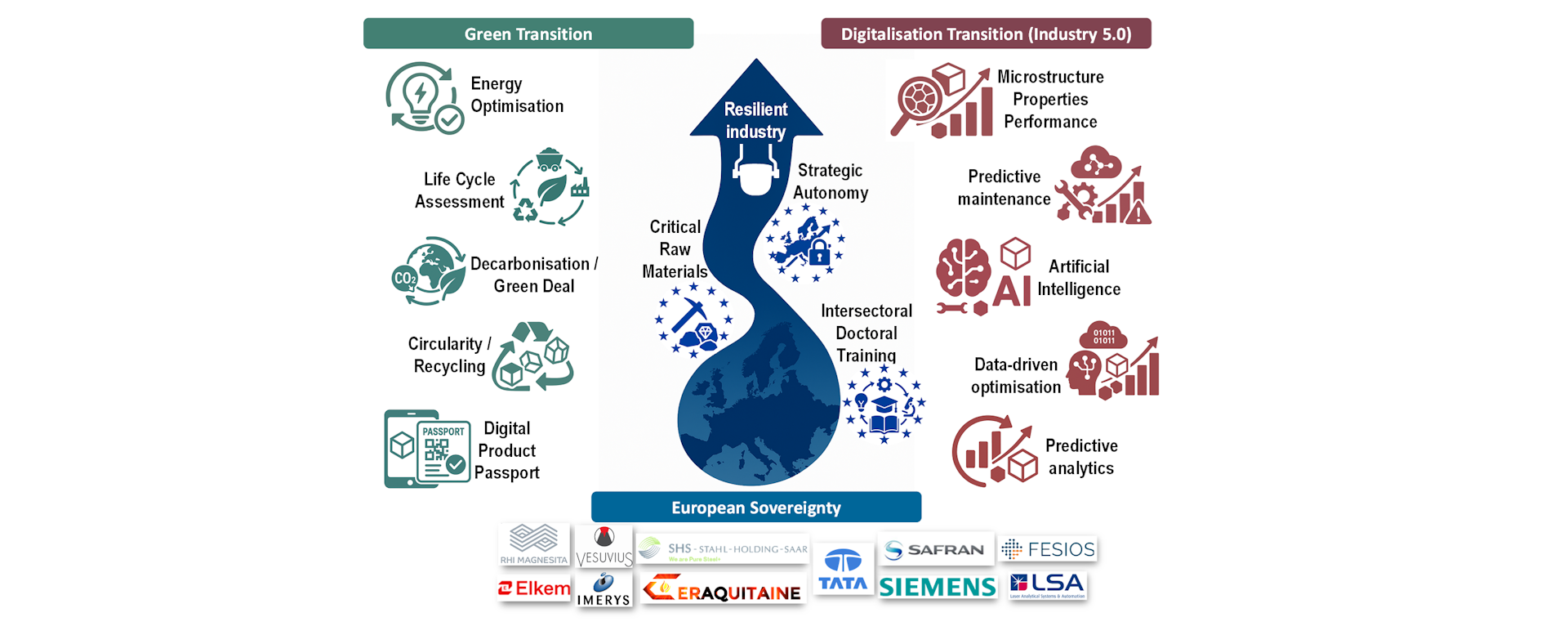
As a consequence, the project is structured around three major pillars:
the green transition,
the digital transition,
and European industrial sovereignty.
These three pillars are fully aligned with European policies such as the Green Deal and the digitalisation of industry, and they directly address the needs of high-temperature industries such as steel, cement and glass.
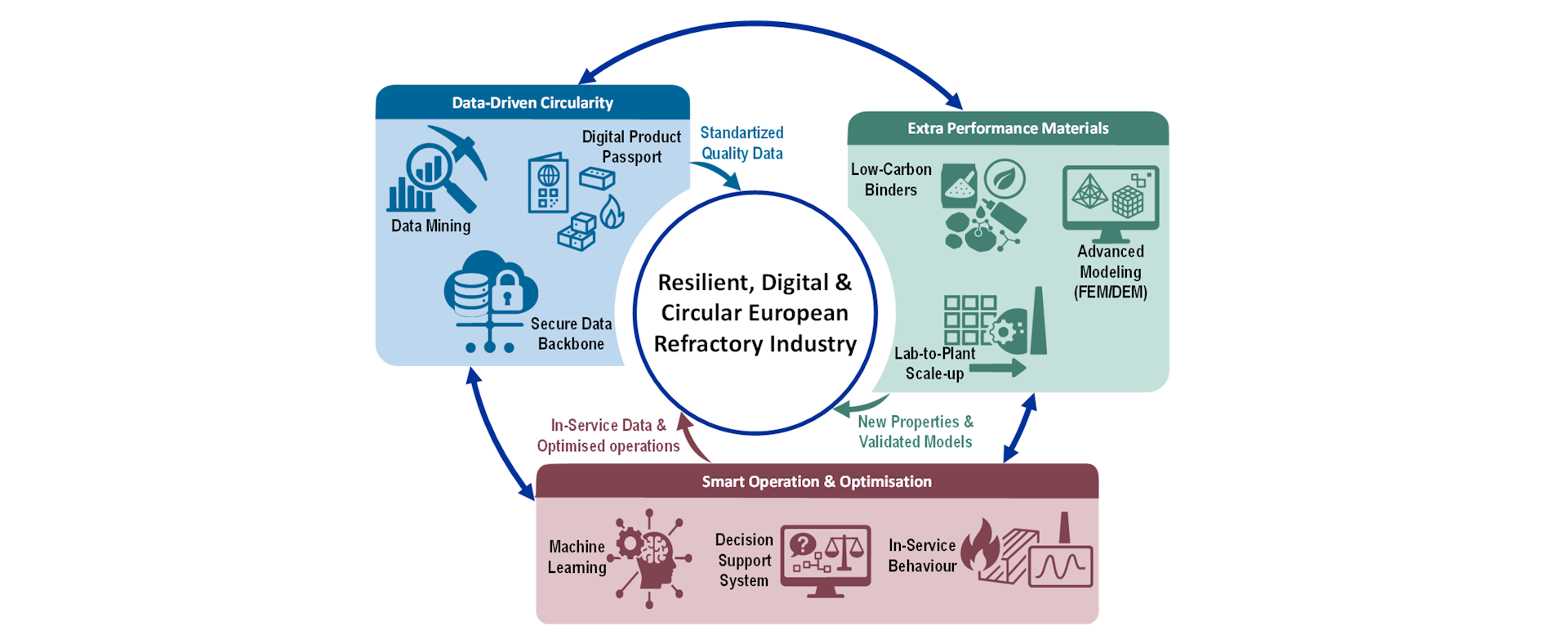
More specifically, REFFRACTEUR aims at contributing to the development of a resilient, digital and circular European refractory industry, by combining advanced materials research, data-driven approaches and sustainability assessment.
To achieve this ambition, the project brings together a new consortium composed of both academic and industrial partners. This consortium has been significantly renewed compared to previous networks, with the integration of new stakeholders across the entire value chain, from raw materials to end-users, including also non-academic partners involved in dissemination, training and outreach activities.
In terms of structure, REFFRACTEUR is organised as an MSCA Doctoral Network – Industrial Doctorate, involving:
15 beneficiaries (academic and industrial),
10 associated partners,
and 15 doctoral candidates, each of them working at the interface between academia and industry.
Each PhD candidate will spend approximately 50% of their time in an industrial environment, ensuring a strong intersectoral dimension and a direct link between research and industrial applications.
The research programme itself is highly integrated and interdisciplinary. It is structured around three main scientific Work Packages:
WP1 – Digitalisation and circularity of refractories, including topics such as Digital Product Passports (DPP), Life Cycle Assessment (LCA), and AI-based quality control for recycling.
WP2 – Advanced materials and microstructure design, focusing on sustainable refractory formulations, microstructure optimisation, and high-temperature behaviour.
WP3 – Digitalisation of operations and optimisation, including multiphysics modelling, machine learning, digital twins, and decision-support systems for industrial processes.
These scientific activities are complemented by transversal Work Packages dedicated to training, dissemination and project management.
One of the key strengths of REFFRACTEUR lies in the strong integration between research and training. The project is designed not only to produce scientific knowledge, but also to train a new generation of researchers capable of working at the interface between materials science, digital technologies and sustainability.
In this respect, a significant effort has been devoted to improving the training programme compared to previous networks. In particular, we have defined explicit training goals covering not only scientific and technical skills, but also transversal competences such as project management, communication, entrepreneurship, and even aspects related to mental health, well-being and resilience.
Each doctoral candidate will follow a personalised training pathway, including:
academic and industrial supervision,
international mobility,
participation in workshops and conferences,
and the development of a Personal Career Development Plan.
Finally, the REFFRACTEUR project also provides 15 fully funded PhD positions, currently open across Europe. These positions cover a wide range of topics, from materials science to digital modelling and sustainability assessment, reflecting the interdisciplinary nature of the project.
All relevant information, including detailed descriptions of each PhD topic, expected profiles and application procedures, is available on the project website:
www.reffracteur.eu
The recruitment process follows the strict rules of the MSCA programme, including the international mobility requirement, which ensures diversity and promotes international collaboration.
In conclusion, REFFRACTEUR represents a major step forward in the structuring of a European ecosystem dedicated to refractory materials. By combining advanced research, digitalisation, circularity and high-level doctoral training, the project aims to contribute significantly to the transformation of high-temperature industries towards more sustainable and resilient models.