Europe’s high-temperature industries, such as steel, cement, and glass, rely on refractory materials that are critical for safe, efficient, and sustainable operations. As the EU is currently under strong Green and Digital Transitions, the refractory sector faces urgent challenges: decarbonisation, circularity, and digitalisation. In this specific industrial sector, current practices are still limited by empirical design, fragmented data, and low recycling rates, while new regulations demand traceability and reduced carbon footprint.
REFFRACTEUR (Digital REFractory FRAmework for a Carbon-neutral and Resilient indusTry in EURope) addresses these challenges by gathering a unique consortium spanning the entire refractory value chain, from raw materials to end-users, across academia and industry. The project will train 15 Doctoral Candidates through an innovative programme combining advanced research in materials science, process engineering, digital tools (AI, digital twins, and sustainability (life cycle assessment). Each researcher will benefit from dual academic/industrial supervision and spend at least 50% of their time in industry, ensuring strong intersectoral skills and real-world impact.
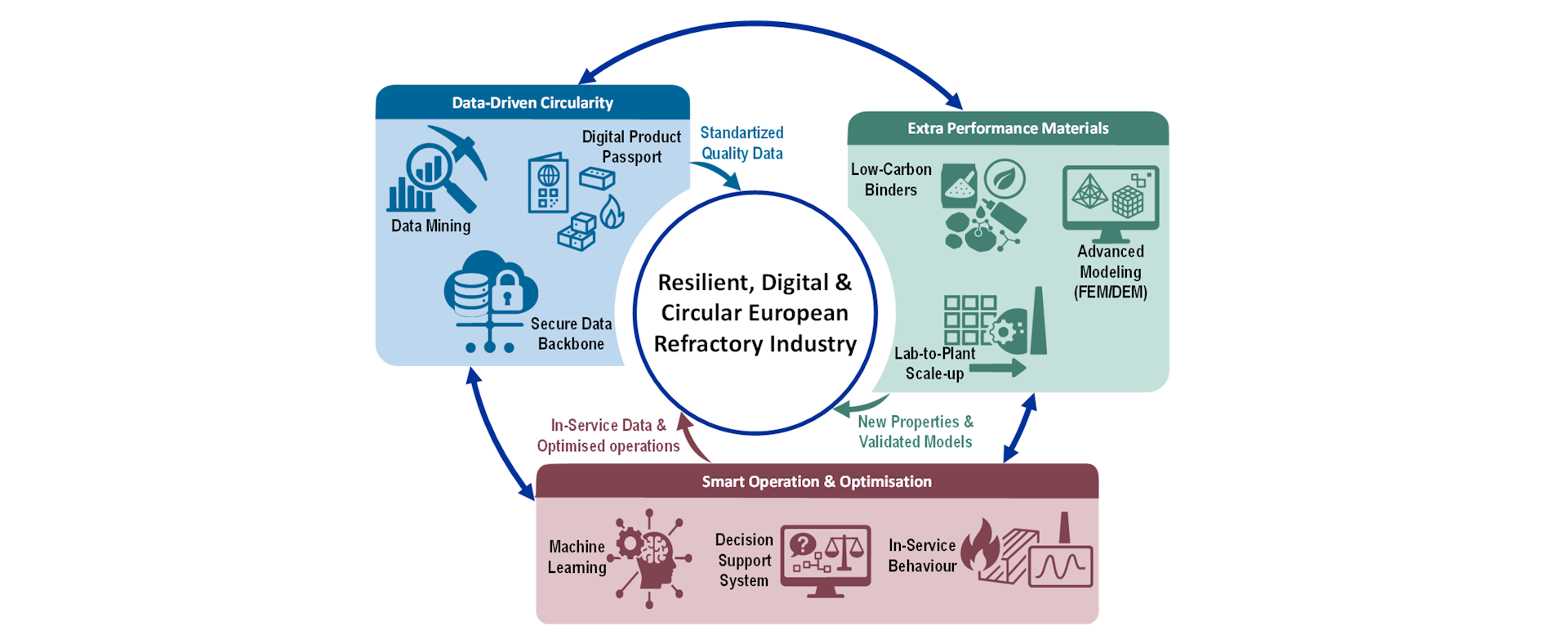
REFFRACTEUR will deliver: (1) new sustainable refractory materials with improved durability and recyclability; (2) the first unified circularity framework for refractories, integrating digital product passports and life cycle assessment; (3) validated digital twins and AI-based decision-support systems for predictive maintenance and energy optimisation; and (4) an open, standardised data backbone to accelerate innovation and knowledge transfer.
By embedding training, research, and innovation in a single European network, REFFRACTEUR will strengthen Europe’s industrial sovereignty, reduce dependency on critical raw materials, and position the EU as a global leader in sustainable, digitalised refractory technologies. The project’s outcomes will directly support the EU’s climate, circular economy, and skills agendas, creating lasting impact for industry, society, and future generations of researchers.
Horizon Europe is the EU’s key funding programme for research and innovation with a budget of €95.5 billion for 7 years, from 2021 to 2027. The first pillar of Horizon Europe programme is dedicated to Excellent Science and thus, supports frontier research and breakthrough scientific ideas, teams up the best researchers (from Europe and beyond) and equips them with skills and word-class research infrastructures. Within this first pilar, Marie Skłodowska-Curie Actions (MSCA) support researchers from all over the world at all stages of their careers, with a focus on their training, skills and career development. The MSCA also support institutions through excellent doctoral and postdoctoral programmes and collaborative projects (Doctoral Networks – DN). They also foster cooperation beyond academia, notably with industry and SMEs. As such, Industrial Doctorates (ID) train PhD candidates at the interface between academic poles and industries. ID PhDs must thus be enrolled in a doctoral programme and jointly supervised by the academic and non-academic partners. To resume, REFFRACTEUR is a Doctoral Network (DN) and is structured around 10 academia, 11 industrial partners and 5 non-profit organisations across the EU, in order to train a cohort of 15 PhDs as Industrial Doctorate (ID) jointly supervised by academic and non-academic partners.
Refractories are unique ceramic materials used in vessel linings and components to contain and process fluids, solids and/or gases at high temperature. They can sustain complex combinations of thermomechanical stresses and chemical/physical wear generated by fluids and chemical agents. Being the only materials able to sustain operation conditions at temperatures typically above 1000 °C, refractories are identified as advanced materials and key enablers of the production of essential products for everybody’s daily life across Europe.
Refractory materials are essential enablers of Europe’s high‑temperature industries. They line furnaces, kilns and reactors in steel, cement, glass and non‑ferrous metallurgy, protecting assets and ensuring safe, continuous operation above 1000 °C. Typical use is 10-15 kg of refractories per tonne of steel and ~4 kg per tonne of glass. While they represent <3% of production costs, refractory design and lifetime can drive up to ~20% of operating efficiency via energy losses, maintenance and downtime; securing a reliable supply of advanced refractories is therefore strategic for EU competitiveness.
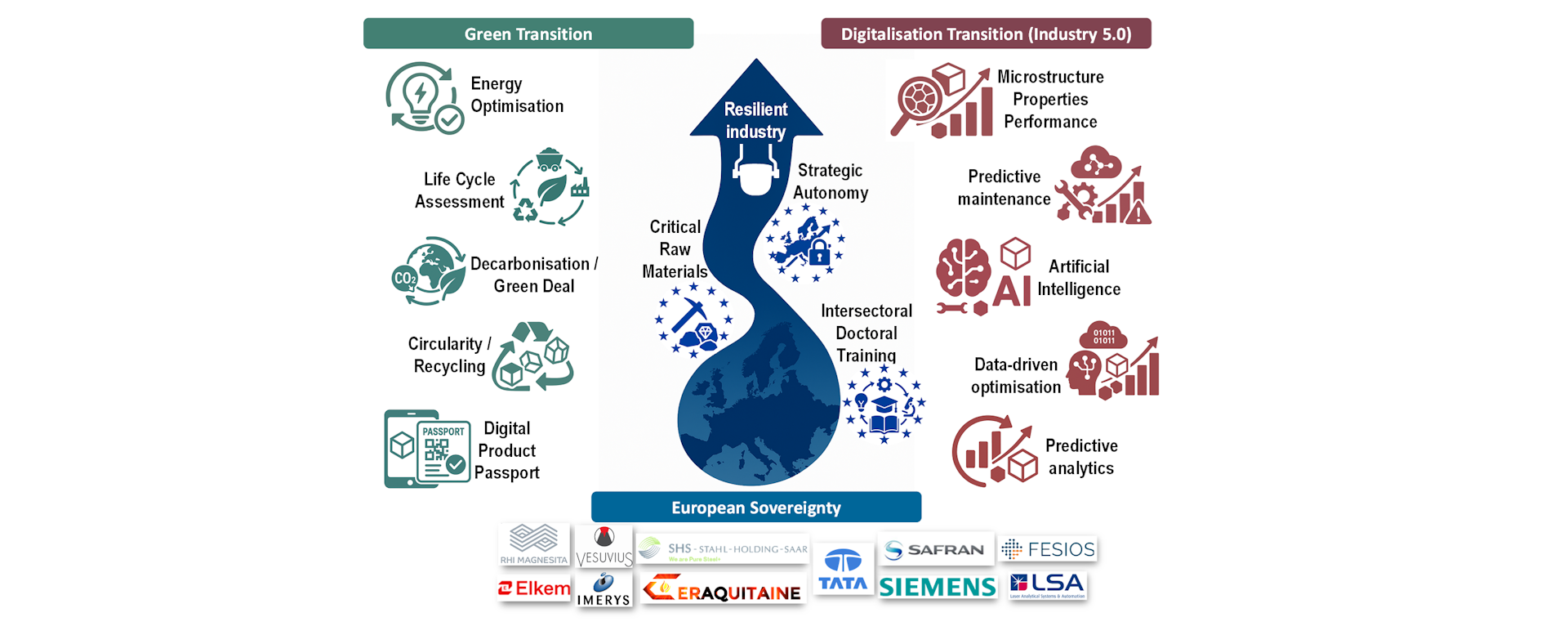
Refractory development is now a climate‑policy and strategic‑autonomy issue. EU objectives (–55% GHG by 2030, climate neutrality by 2050) and the Clean Industrial Deal intensify pressure on energy‑intensive sectors, alongside circular‑economy and critical‑raw‑materials ambitions. Carbon pricing (EU ETS) and CBAM increase the cost of CO₂, so lower‑carbon refractories and longer‑lasting linings become a direct lever to curb carbon expenditure and keep plants competitive under tightening regulation.
At the same time, low‑carbon process routes (H‑DRI, electric arc furnaces, low‑carbon clinkers, carbon capture) introduce new service environments: H₂/O₂‑rich atmospheres, stronger thermal cycling and corrosion from alternative fuels. Global competition in clean‑tech manufacturing is accelerating. Accordingly, priorities have shifted from durability and cost alone to environmental performance, combining microstructural engineering with life‑cycle thinking (purer chemistries, recyclable binders, lower‑carbon raw materials). Circularity is pivotal: ~28 Mt of spent refractories are generated annually, yet recycling remains limited and several inputs are import‑dependent, calling for better sorting, characterisation and processing to close loops and recover value.
Life‑cycle assessment and product carbon‑footprint frameworks increasingly quantify and steer improvements. In parallel, the sector is digitalising rapidly. The Ecodesign for Sustainable Products Regulation will require Digital Product Passports, enabling traceability of composition, use‑phase and end‑of‑life data; for refractories, DPPs can track identity, performance and recyclability from production to dismantling. Operators are deploying sensors, IoT and digital twins for real‑time lining monitoring, predictive maintenance and energy optimisation, while AI supports in‑line quality control and wear/failure prediction.
Delivering these shifts at scale requires skills for the twin green–digital transition. Building on ATHOR and CESAREF, the MSCA Doctoral Network REFFRACTEUR will train researchers to design, simulate, characterise and recycle next‑generation refractories through close academia-industry collaboration, adding a sector‑specific DPP, physics‑informed digital twins and decision support for melt‑shop decarbonisation, complemented by entrepreneurship and change‑management competences.
Designed to raise the attractiveness and excellence of doctoral training in Europe, CESAREF will: Deliver the best training to doctoral candidates and address their scientific and transversal needs. FIRE conducts regular surveys to identify the missing needs, Enable doctoral candidates, through their tailored training and international, interdisciplinary, and inter-sectoral mobility, to “cross-pollinate” industry and academia, Give the candidates the opportunity to be close to industry with an innovation-oriented mind-set and to face actual engineering challenges, Develop new characterization devices and modelling methods to offer solutions to current Scientific/Technological challenges, Create a multidisciplinary environment where industries and academia will share ideas and find innovative and sustainable solutions together, Explore the capability of advanced numerical modelling to design better materials and refractory linings to improve their energy efficiency and thermomechanical properties, Apply eco-design concepts to decrease the impacts of refractories on the environment through their life cycle (raw material choice, production, use in life, recycling at the end of life), Leverage digitalization methods to improve energy efficiency of the Iron & Steel process and reduce CO2 emissions, Assist the European refractory and steelmaking industries to identify technological improvements by providing high performance characterization and modelling tools which will enhance their competitiveness. The major contributions and breakthroughs anticipated from CESAREF network are in the following areas:
News
International | News | Presse | Recrutement